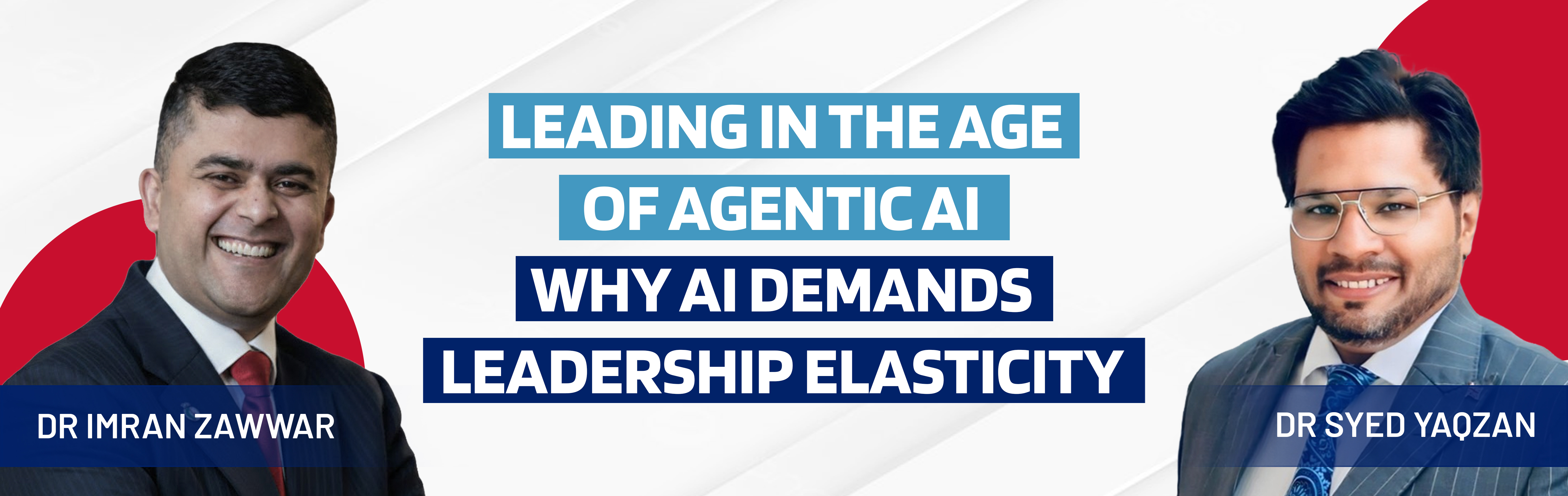
Leading in the Age of Agentic AI: Why AI demands Leadership Elasticity
We are living in one of the most transformative periods in human history.
Technologies like agentic AI and digital twins are not just reshaping industries — they are redefining leadership itself.
And yet, amid all this innovation, one emotion continues to dominate boardrooms: uncertainty.
The Leadership Paradox: Expected to Lead Without a Map
Leaders today are facing a unique paradox. They are expected to provide direction, make high-stakes decisions, and deliver outcomes — but in a world where the rules are constantly changing. Even the most seasoned leaders admit they can't predict what's going to happen.
This is not a failure of leadership — it's a reflection of the environment.
The traditional leadership model — linear thinking, structured planning, predictable scenarios — is no longer enough.
Time calls for Leadership Elasticity
The leaders who will thrive are not the ones with all the answers, but those who can:
This is what we call leadership elasticity — the ability to stretch, respond, and evolve under pressure.
From Information Overload to Clarity
Today's organisations are drowning in data. Leaders are handed layers of information they must untangle before making decisions. This overload fuels hesitation and fear:
What if the decision is wrong? What if the outcome is unclear? What if we move too early or too late?
This is where AI becomes transformational — not as a replacement, but as an amplifier. At its best, AI:
It doesn't replace leadership — it frees leaders to lead.
Agentic AI: Threat or Opportunity?
One of the biggest fears surrounding AI is job loss and economic disruption. But history tells a different story.
In just 100 years, the global population grew from 2 billion to over 8 billion — and yet we created jobs, built economies, and expanded industries. AI is no different.
Yes, it will disrupt jobs. But it will also:
The real shift is not job loss — it's job transformation.
The Missing Piece: Ethics, Values, and Boundaries
Amid all the excitement around agentic AI, one critical gap remains: the foundation is incomplete without ethics.
AI agents are becoming more autonomous. But autonomy without boundaries is risk. Leaders must ensure:
Because ultimately: technology reflects the values of those who build it.
This is where leadership becomes not just strategic — but moral.
Digital Twins: A Glimpse Into the Future
Imagine an AI that understands you better than you understand yourself — knows your context, industry, and goals, and coaches you in real time.
This is already happening. Through digital twins, organisations are automating coaching and mentoring, scaling personalised development, and enhancing decision-making at speed.
In one example, thousands of participants in a startup ecosystem are guided by AI-driven avatars that analyse their profiles, understand market conditions, and build real-time business plans.
This isn't science fiction — it's the new operating model.
The Shift: From Transactions to Value Ecosystems
Another major transformation is in how organisations operate.
The Old Model: Transactional, cost-driven, proposal-based.
The New Model: Partnership-driven, impact-focused, value ecosystem-oriented.
Organisations are no longer buying services — they are co-creating outcomes.
So, What Should Leaders Do Next?
There is no universal formula. Every organisation is different. But three powerful starting points emerge:
The Future Is Not About AI — It's About Leadership
Agentic AI will continue to evolve. Digital twins will become more powerful. Automation will accelerate. But the real differentiator will not be technology — it will be leaders who can navigate uncertainty, act with clarity, and lead with values.
Because in a world driven by intelligent machines… the most valuable trait will still be human judgement.
Authors

LSC Team
Edited and repurposed by
London Strategy Centre
Download Article
Save this article as a PDF to read offline or share with your team.
Newsletter
Get the latest insights from LSC delivered to your inbox.
Featured Campaigns and Collections

17TH JUNE, 2025
Women's Leadership: What Exactly Are We Trying to Fix?

17TH JUNE, 2025
Women's Leadership and Gender Diversity; not just 'nice to haves' but differentiators

11TH JUNE, 2025
The Limelight Or The Shade

5TH JUNE, 2025
Caught in the Crossfire: Can Climate Action Survive Rising Geopolitical Tensions?
17TH JUNE, 2025
Women's Leadership: What Exactly Are We Trying to Fix?
17TH JUNE, 2025
Women's Leadership and Gender Diversity; not just 'nice to haves' but differentiators
11TH JUNE, 2025
The Limelight Or The Shade
5TH JUNE, 2025
Caught in the Crossfire: Can Climate Action Survive Rising Geopolitical Tensions?
25TH MAY, 2025