Aviation Technical Operations
AI Agents for Documentation & Fault Resolution
Executive Summary
LSC transformed aviation technical operations by deploying a voice-enabled AI assistant that gives engineers instant access to maintenance manuals, service bulletins, regulatory requirements, and historical maintenance data. By eliminating the time spent searching and cross-referencing documentation, engineers can diagnose and resolve faults faster while maintaining full compliance and safety.
The result is reduced Aircraft on Ground (AOG) time, quicker onboarding of new engineers, and more efficient maintenance operations without replacing human expertise.
Context
Aviation technical operations run on documentation. Airworthiness Directives, Aircraft Maintenance Manuals, Service Bulletins, fault isolation manuals, and engineering orders constitute a library that grows continuously and must be applied precisely. Engineers operate under time pressure, in operational environments, working directly on aircraft — and are expected to locate, interpret, and apply the correct procedure without error or delay.
The Problem
The systemic failure is documentary, not technical. Every unfamiliar fault or complex maintenance update requires an engineer to resolve a documentation problem before they can address the engineering one. Retrieving the right procedure takes time. Cross-referencing between manuals introduces error. Delays accumulate. Aircraft on Ground (AOG) time increases — and the cost of that time is measured in hours, not inconvenience. When an engineer is uncertain, they stop. That is the correct safety behaviour. But when the blockage is documentary rather than technical, the stoppage compounds into an operational and commercial problem.
LSC's Approach
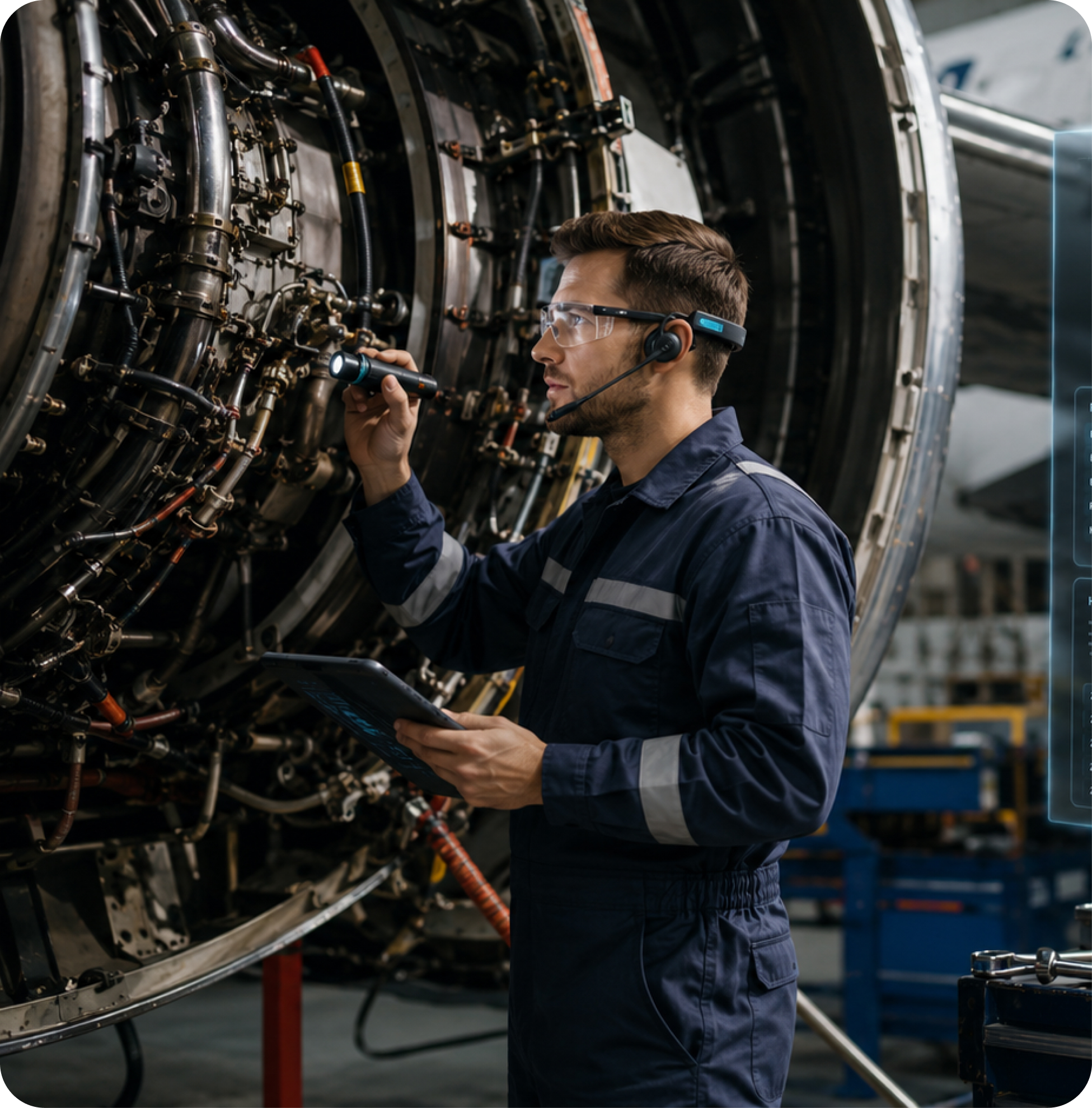
LSC deployed a Tier 3 — Cybernetic Organisation Design solution for aviation technical operations. The architecture is a voice-enabled agentic system that sits alongside the engineer as they work: always present, always current, always referenced to source documentation. The system has ingested the full technical documentation library — manuals, bulletins, fault codes, historical maintenance records, and regulatory requirements — and makes that intelligence immediately accessible through natural conversation.
An engineer describes a fault. The agent surfaces the relevant procedure, highlights required tools and consumables, flags open Airworthiness Directives, and cross-references historical fault data from comparable aircraft across the fleet. The engineer's judgement is not replaced. The documentary friction that delays it is eliminated. This is AI-augmented transformation applied at the point of work — not in a dashboard, not in a report, but at the aircraft.
What Changed
Technical documentation retrieval time dropped from minutes to seconds. Engineers work through faults without leaving the aircraft to consult physical or digital manuals, reducing both error and time lost. AOG resolution pathways are identified faster, directly reducing ground time and the operational costs it generates. New engineers reach full operational competence more quickly, supported by continuous, contextual guidance that accelerates experience without substituting for it.
The Principle
The bottleneck was never the engineer’s competence. It was the time between a fault and the right procedure. That gap has been closed.